Main Types of Rice Milling Machines
Different rice milling technologies are suitable for different applications.
Abrasive Rice Milling Machine
Abrasive rice mills use an abrasive roller to remove the bran layers from brown rice. They are commonly used in rice whitening applications where controlled surface removal is required.
Friction Rice Milling Machine
Friction rice mills use pressure and friction between the rice kernels and the milling components to remove bran. Their performance depends on the machine design and the selected operating parameters.
Combined Rice Milling Machine
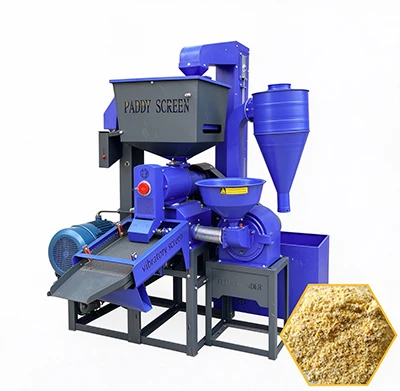
Combined rice milling machines integrate multiple processing functions into one unit. Depending on the design, they can be suitable for small and medium-sized rice mills that require a compact equipment configuration.
Complete Rice Milling Production Line
For commercial rice processing plants, a complete rice milling line offers a more integrated solution. It can include cleaning, destoning, husking, paddy separation, milling, polishing, grading, color sorting, and packaging equipment.
What Factors Affect Rice Milling Quality?
The quality of finished rice depends on more than the milling machine alone.
Important factors include:
• Paddy moisture content: Improper moisture conditions may increase the risk of grain cracking and breakage.
• Rice variety: Different varieties have different grain shapes, hardness, and processing characteristics.
• Milling degree: Excessive milling may reduce head rice yield, while insufficient milling may leave too much bran on the rice surface.
• Machine adjustment: Appropriate feed rate, pressure, and operating settings help maintain consistent processing performance.
• Equipment matching: Proper coordination between the husker, separator, milling machine, polisher, and grader supports stable production.
Careful process control helps rice processors balance whiteness, grain integrity, processing efficiency, and product quality.
How to Choose the Right Rice Milling Machine
Before purchasing rice milling equipment, customers should evaluate their actual production requirements.
Production capacity
Determine whether the required output is measured in tons per hour (TPH) or tons per day (TPD). Daily capacity also depends on the number of operating hours.
Raw material characteristics
Consider the rice variety, initial moisture content, impurity level, and condition of the paddy.
Finished rice requirements
Different markets may have different expectations for whiteness, broken rice percentage, grain uniformity, and appearance.
Automation level
Small rice mills may prefer a compact or semi-automatic configuration, while large processing plants may benefit from integrated material handling and automatic control systems.
Maintenance and operating costs
Consider power consumption, wear parts, cleaning requirements, spare parts availability, and the long-term reliability of the equipment.
Future expansion
If production is expected to grow, it is important to plan the production line layout and equipment capacity accordingly.
Why Is a Complete Rice Milling Solution Important?
A complete rice milling plant requires all major machines to work together efficiently. If one machine has insufficient capacity or causes material flow problems, the performance of the entire production line may be affected.
Professional process design helps coordinate the capacities of individual machines, improve material flow, and reduce unnecessary interruptions.
For customers building a new rice mill or upgrading an existing facility, equipment selection should be based on the complete production process rather than the specifications of a single machine.
Conclusion
Rice milling machines are essential for modern rice processing. By selecting suitable equipment and optimizing the processing flow, rice mills can improve production efficiency, maintain consistent rice quality, and reduce unnecessary grain breakage.
Whether you need a single rice milling machine or a complete rice milling production line, the right configuration depends on your processing capacity, raw material characteristics, finished rice requirements, and installation conditions.
If you are planning a rice milling project, contact us with your target capacity, rice variety, and product requirements. We can recommend suitable rice milling equipment and a processing solution tailored to your project.